Aging: A Family Process
The Hidden Price of Silence: Why Families Who Plan Together Save Millions
A conversation today could save your family tens of thousands of dollars, and its relationships, tomorrow.
Most American families don't talk about what happens when mom or dad starts to decline. It feels morbid, premature, or just plain uncomfortable. So they wait. And that waiting, it turns out, is extraordinarily expensive.
The American elder litigation system is quietly consuming somewhere between $10 and $22 billion every year — not after parents die, but while they're still alive. Guardianship battles. Financial abuse lawsuits. Medicaid disputes. Sibling conflicts over who holds power of attorney. These are the legal costs of families who never had the hard conversations — and the courts are full of them.
The Numbers Are Staggering
Each year in the United States, more than 140,000 new guardianship and conservatorship petitions are filed in courts — and that's based on incomplete reporting from only 34 or 35 states. The true number is likely far higher. Right now, an estimated 1.3 million Americans are living under court-ordered guardianship, with their most basic life decisions — where they live, how their money is spent, what medical care they receive — controlled by someone a court appointed because the family couldn't agree, or never planned.
The cost of each of those cases? An uncontested guardianship runs $5,000 to $15,000 in attorney's fees. A contested one — where siblings disagree, or a parent resists, or someone challenges who should be in charge — can easily exceed $30,000 to $50,000 or more. Those fees typically come directly out of the parent's assets. The family doesn't just lose money. It loses time, trust, and in many cases, the relationship itself.
Elder financial abuse adds another brutal layer. Researchers estimate it costs American seniors at least $2.9 billion per year in direct losses — with legal fees and recovery costs piled on top. The painful reality: the perpetrators are most often not strangers. They are adult children, caregivers, and other close family members who stepped into a vacuum of unclear authority and took advantage of it.
The Real Cost Isn't Legal. It's Human.
Behind every guardianship petition is a family that ran out of road. A parent whose wishes were never written down. Adult children who each believed they knew best. A diagnosis that arrived faster than anyone expected.
The courts don't resolve these situations so much as they adjudicate them. A judge decides who was right. But no ruling gives back the Thanksgiving dinners that won't happen, the phone calls that stopped, or the trust that was broken when one sibling hired a lawyer against another.
What families spend in litigation — in dollars, years, and emotional capital — is the direct cost of conversations that never happened.
What Planning Actually Costs
Here's the contrast that should stop every adult child in their tracks.
A comprehensive elder law plan — the documents, the conversations, the clarity about who decides what and when — typically costs a family $3,000 to $12,000. That includes a will, a durable power of attorney, a healthcare directive, and in many cases a basic trust. For families with more complex assets, Medicaid pre-planning adds another layer, typically running $5,000 to $15,000 — but potentially preserving hundreds of thousands in assets that would otherwise be consumed by nursing home costs.
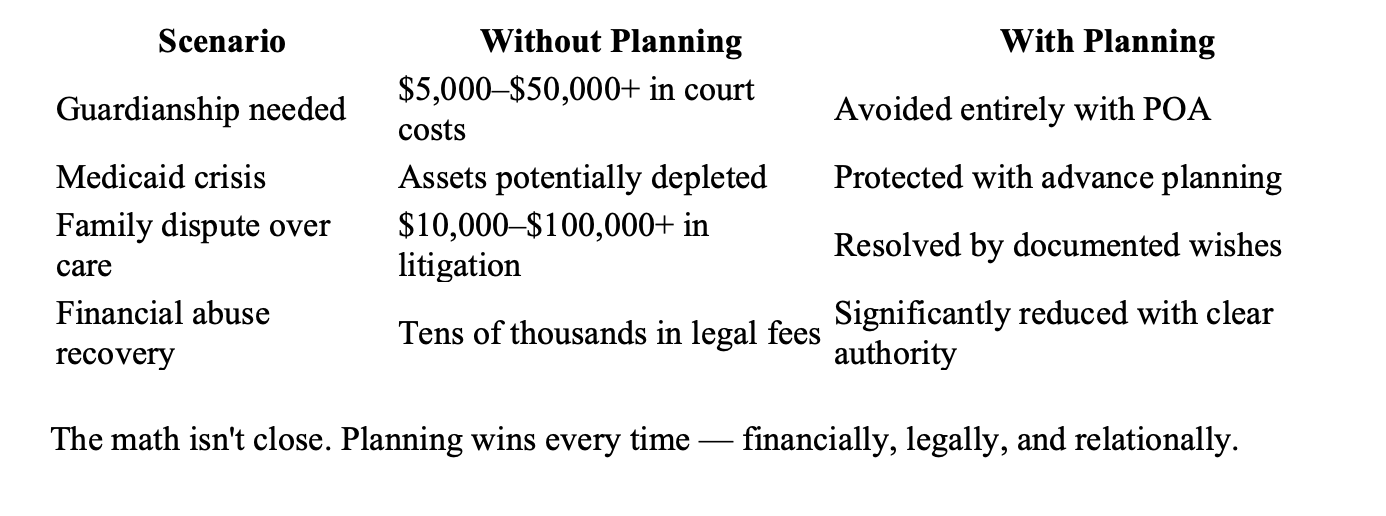
Compare that to the cost of not planning:
The math isn't close. Planning wins every time — financially, legally, and relationally.
Why Families Still Don't Do It
If the economics are so clear, why do millions of families still end up in court?
The answer isn't ignorance. It's avoidance. Talking about a parent's incapacity means confronting mortality — theirs and eventually our own. It means having direct conversations about money in families where that topic has always been off-limits. It means one sibling potentially saying to another: I think I should be the one in charge, and the other disagreeing.
It is uncomfortable. It can be awkward. It sometimes surfaces old wounds.
But here's what's also true: those conversations are far less painful before a crisis than during one. When a parent is healthy enough to participate — to express their own wishes, to name their own values, to say what matters to them — the family has a chance to reach genuine agreement. Once a diagnosis arrives, or a fall happens, or a bank account gets drained, that window closes. What remains is conflict, lawyers, and courts.
Golden Agreements: The Work Worth Doing
This is exactly the work that Golden Agreements exists to support. Not legal documents alone — though those matter — but the conversations that make those documents meaningful. The family meeting where mom says what she actually wants. The moment when siblings hear each other, not as rivals for control, but as people who all love the same person. The plan that everyone understands, not just the one who hired the attorney.
Families who do this work don't end up in guardianship court. They don't spend their inheritance on lawyers. They don't lose each other over a parent's decline.
They grieve together instead of fighting each other. And when the time comes, they can say: we handled this well. Mom would be proud.
The cost of a conversation is measured in discomfort. The cost of avoiding it is measured in dollars, years, and relationships.
Golden Agreements helps families have the conversations that protect everyone — before the crisis, before the courts, and before it's too late.
For more information on the information in this article:
On guardianship and conservatorship volume:
National Center for State Courts (NCSC), via Justice in Aging — estimate of 1.3 million adults currently under guardianship or conservatorship, controlling roughly $50 billion in assets. https://justiceinaging.org/guardianship-data-reform/
NCSC / National Guardianship Association, via academic review in Gerontology & Geriatrics (Taylor & Francis, 2024) — 35 states reported 92,117 new adult guardianship petitions; 34 states reported 51,157 new conservatorship petitions in a recent filing year. https://www.tandfonline.com/doi/full/10.1080/08959420.2024.2349494
National Council on Disability, Beyond Guardianship: Toward Alternatives That Promote Greater Self-Determination (2018) — foundational estimate of 1.3 million active cases and $50 billion in assets under management. https://www.ncd.gov/assets/uploads/reports/2018/ncd_beyond_guardianship.pdf
On guardianship costs:
LGK Lawyers, How Much Does an Elder Law Attorney Cost in New York? (2026 Guide) — uncontested Article 81 guardianship in NYC runs $5,000–$12,000; contested matters run significantly higher. https://www.lgklawyers.com/blog/elder-law-attorney-cost-new-york
Lawwalls.com, How Much Do Elder Law Attorneys Charge: Updated Costs 2026 — guardianship attorney fees of $3,500–$15,000+ before court filing costs, with contested cases running higher. https://lawwalls.com/how-much-elder-law-attorneys-charge
Hackard Law, Understanding the Cost and Value of an Elder Law Attorney — hourly rates of $250–$500 for contested guardianships; comprehensive packages $5,000–$12,000+. https://www.hackardlaw.com/elder-law-attorney-cost-and-value/
On elder financial abuse:
MetLife Mature Market Institute, Broken Trust: Elders, Family and Finances — elder financial exploitation costs seniors at least $2.9 billion annually; up to 1 million older Americans targeted yearly. Cited in: Skees, S., A Scoping Review of Financial Elder Exploitation Interventions, published in Gerontology (2021). https://www.ncbi.nlm.nih.gov/pmc/articles/PMC8679543/
On Medicaid planning costs:
Marc Whitehead & Associates / disabilitydenials.com, How Much Do Elder Law Attorneys Charge? — Medicaid planning attorney fees typically range from $3,000–$15,000 depending on state and asset complexity. https://disabilitydenials.com/faqs/how-much-do-elder-law-attorneys-charge/
LGK Lawyers (2026) — Medicaid asset protection trusts typically cost ~$5,000 but can protect against $14,000–$18,000/month nursing home costs that could otherwise exhaust assets in four to five years. https://www.lgklawyers.com/blog/elder-law-attorney-cost-new-york
On probate volume:
Probate Court Bond / National Center for State Courts (2023) — approximately 2.6 million probate cases filed annually in U.S. state courts; probate courts handle over $60 billion in estate assets annually. https://www.probatecourtbond.com/probate-statistics-united-states/
On data limitations:
Conference of Chief Justices / Conference of State Court Administrators (2009, updated) — most state court systems cannot accurately track guardianship, conservatorship, and elder abuse cases filed, pending, or closed each year. https://ccj.ncsc.org/resources-courts/encouraging-collection-data-adult-guardianship-adult-conservatorship-and-elder
Elders and Courts / National Center for State Courts, Obtaining Reliable Guardianship Data — data on guardianship cases nationally remains unreliable or unavailable in most states, with estimates based on a small number of reporting jurisdictions. https://www.eldersandcourts.org/guardianship_conservatorship/general-information/basics/data